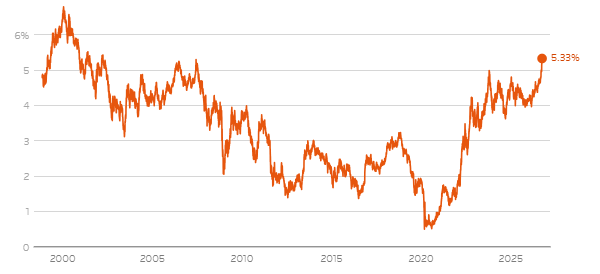
Global bond markets experienced significant selling pressure on Thursday, leading to sharp increases in borrowing costs across various countries, including the United States, France, and Japan, with US Treasury yields reaching a 24-year high. This situation highlights the increasingly concerning climate for policymakers regarding rising interest rates. In the late US morning, however, some bargain hunters entered the market, which helped stabilize the situation temporarily. Consequently, the US benchmark yield fell back to approximately 5.26%, alongside a decrease in Treasury yields across the yield curve. Analysts suggest that despite this brief respite, there may still be potential for further selling pressures in the future.

Global Bond Higher interest rates have led to increased financing costs for companies and mortgage borrowers, compelling governments to allocate more funds for interest payments. This situation has arisen as bond yields, which rise when prices decrease, have significantly increased globally, largely due to skyrocketing energy costs that contribute to inflation. The rising demand in sectors such as artificial intelligence and data-center construction has intensified competition for capital, consequently heightening expectations regarding economic growth and the stability of short-term interest rates.
Global Economic Concerns Grow Amid Rising Borrowing Costs
Global Bond Specifically, the US 10-year Treasury yield, an important benchmark for global borrowing costs and asset valuations, reached 5.34%, marking its highest level since 2002. This surge follows the most substantial quarterly rise in yields observed this century, which occurred during the three-month period concluding in September. As yields have increased, financial conditions are expected to tighten, potentially raising the risk of an economic slowdown, according to Danny Zaid, a portfolio manager at TwentyFour Asset Management in New York. Despite these concerns, he emphasizes that the broader economy remains strong, although it operates within a K-shaped framework.

Global Bond In this context, the K-shaped economy illustrates a disparity in economic recovery, where wealthier individuals flourish while lower-income workers face ongoing hardships, necessitating relief from rising oil prices. Additionally, Fred Neumann, HSBC chief Asia economist, notes that the markets are reacting to several years of inflation above target levels. He further explains that until monetary tightening occurs, bond markets will likely demand a premium for long-term borrowing. This highlights the complex interplay between inflationary pressures, market responses, and the uneven recovery experienced across different socioeconomic groups.
France In Focus
Global Bond France is currently a focal point for bond investors, with significant attention on the government upcoming 2027 budget bill, scheduled for presentation on Thursday. The bill is anticipated to face difficulties in passing, particularly due to the proposed unpopular belt-tightening measures aimed at fiscal consolidation. This legislative challenge is underscored by the recent rise in French 10-year borrowing costs, which have reached their highest levels since 2002, nearing the critical 5% threshold. These developments reflect a concerning trend, as the country bonds have experienced their worst quarterly performance since 1987 in the period ending September.
Global Bond The spread between the 10-year borrowing costs of France and Germany has reached levels not seen since the eurozone debt crisis of the 2010s. Additionally, the expense of insuring French debt against the risk of default has surged to the highest point since 2013. There are ongoing discussions about the potential role of the European Central Bank in supporting France bond market; however, market participants consider such intervention unlikely at this moment.
Global Pressure
In a recent analysis by the Institute of International Finance, it was highlighted that advanced economies have faced a significant financial burden due to soaring interest payments on government bonds. Over the past year, these nations collectively paid more than $3.3 trillion in interest alone surpassing global expenditures on other major sectors such as artificial intelligence ($2.6 trillion), defense ($3.1 trillion), and clean energy ($2.3 trillion).
Global Bond In the UK, the yield on 30-year government bonds has surged past 6%, marking the highest level since 1998. This spike in yields reflects broader economic pressures, with UK house prices experiencing their slowest growth rate in nearly two years, indicating the adverse effects of rising interest rates on the housing market and the real economy at large.

Meanwhile, Japan is witnessing a remarkable shift in its economic landscape. Following a prolonged struggle with deflation, the country is now grappling with inflation, driving sovereign yields to achieve an unprecedented fifth consecutive quarter of double-digit gains. This scenario underscores the global nature of rising yields and their implications for government finances and economic stability. Global Bond
French-German 10-year bond yield gap trading near widest since 2012

Stocks Hold Up For Now
Factory activity in Europe and Asia showed expansion last month, largely driven by investments related to artificial intelligence (AI). This uptick in growth has provided central banks with less cause for concern regarding the impacts of tightening monetary policies. According to Afonso Borges, an analyst at Julius Baer, the stronger economic performance has led markets to anticipate that the economy can endure higher interest rates for an extended period. Global Bond
Global Bond As a result, traders are re-evaluating previous predictions regarding potential interest rate cuts from the U.S. Federal Reserve for this year. Following a rate hike last month, expectations now include at least three additional increases before mid-2027, despite recent cooler inflation data that temporarily eased near-term forecasts. In Europe, inflation figures have been higher than anticipated, prompting the European Central Bank to implement two rate hikes this year. Markets are currently factoring in three more increases of 25 basis points each by mid-2027.
Global Bond While various assets, including stocks and credit, exhibited nervousness on Thursday, the bond market faced significant selling pressure, bearing the most significant brunt of market reactions. Concerns regarding credit also surfaced in the derivatives market, with an index measuring junk bond credit default swaps reaching its highest level since early April, indicating heightened risk perceptions associated with defaults in the junk bond sector.
US 10-year Treasury yield hits highest since 2002
Summary
- US 10-year Treasury yield at its highest level since 2002
- French 10-year bond yield nears 5% as govt presents budget
- Britain 30-year yield crosses 6%, highest since 1998
- Strong economic growth hurts bonds, helps equities
Pingback: Report Nasdaq Hits Record High After Softer Jobs Data Tempers Rate-Hike Bets - internationalmediawire.com