
A “vanishingly rare” copy of the U.S. Declaration of Independence has been discovered in London, specifically within archives associated with documents from the British seizure of an American privateer ship in 1776. This find coincides with the United States’ 250th anniversary celebrations. Historically significant for its expressions advocating “life, liberty and the pursuit of happiness,” this particular text had previously been cataloged in 18th century records as merely “another document.” The breakthrough occurred in May when a volunteer at Britain’s National Archives examined the records more closely, uncovering the true nature of this important artifact.U.S.
U.S. Declaration A 1776 copy of the U.S. Declaration of Independence, part of the rare “Exeter Declarations” with only 11 surviving copies, has been uncovered at The National Archives in Kew. This particular copy is significant as it is the first to be located outside of the United States. The discovery was captured in a handout image obtained by Reuters on July 3, 2026.A rare surviving copy of the Declaration of Independence has been discovered at The National Archives in Kew, marking it as the only known example outside the U.S. This significant find occurred in February when volunteer Michael Scurr was cataloguing papers related to Royal Navy captains from the American Revolutionary War.
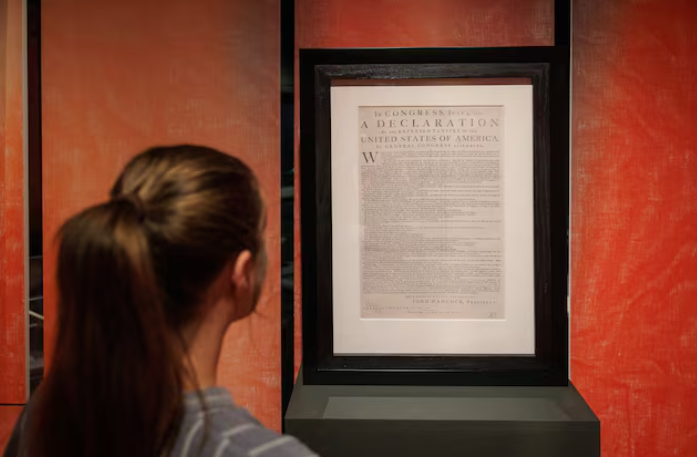
U.S. Declaration The document is one of just 11 copies printed in Exeter, New Hampshire in July 1776, specifically created to disseminate information regarding American independence throughout the colonies before being seized by British forces.
Upon uncovering the document, Scurr experienced a rush of excitement, prompting him to alert his supervisor to the find. The Exeter Declaration is recognized as a remarkable artifact; Saul Nassé, the Chief Executive of The National Archives, described it as “extraordinary” and noted that it is a “vanishingly rare” surviving copy discovered outside of America. The declarations were originally produced as part of efforts to communicate the events surrounding the signing of the Declaration of Independence and were frequently transported on ships. This discovery provides critical insight into the historical spread of information regarding the United States’ independence during the Revolutionary War.
First Declaration Found Outside the U.S.
On the eve of the U.S. semiquincentennial celebration of its Declaration of Independence from Britain, news emerged about the first declaration found outside the United States. This announcement coincides with a significant historical moment, as millions of Americans prepare for July 4 celebrations, which commemorate the adoption of the Declaration of Independence by Congress in 1776. During that revolutionary period, printers played a crucial role in disseminating the declaration, eager to share this foundational document of the new nation across the colonies.
The discovered document in London was printed in Exeter, New Hampshire, in mid-July 1776, representing the 11th surviving copy of the “Exeter Declarations” and the first found outside the United States. Eleazer Johnson, captain of the Dalton ship, acquired this copy months later before embarking on a mission to capture British vessels, likely aiming to motivate his crew to support the emerging nation.
U.S. Declaration However, on December 24, 1776, the Royal Navy intercepted the Dalton off the coast of Portugal, capturing the ship and its contents, which were subsequently taken to Plymouth, England. The National Archives identified this document as the only known declaration obtained through military action. Due to the legal protocols of late 18th century England, British captains were required to present any captured ship’s documents to authorities to claim their prize shares.
U.S. Declaration During the American Revolutionary War, the British confiscated 3,600 ships, creating a substantial archive of historical records at the National Archives. This extensive documentation provides an invaluable resource for historians, offering a detailed background that is often absent from surviving declarations. According to Graham Moore, a curator at the National Archives, the bureaucratic procedures associated with wartime efforts have resulted in a uniquely rich narrative that enhances our understanding of this period.
Rare Declaration of Independence Found in the UK
Following restoration works, a rare copy of the Declaration of Independence will be displayed in an exhibition at The National Archives, dedicated to the path to American independence, which recently opened. Saul Nassé, the chief executive of The National Archives, hailed this find as “an extraordinary discovery” and emphasized its uniqueness, noting it was not found in America but in the UK.
U.S. Declaration This particular document was seized by the Royal Navy on Christmas Eve in 1776, when the HMS Raisonable captured the American ship Dalton off the Portuguese coast after a seven-hour chase. Dr. Graham Moore from The National Archives elaborated on its significance, stating it is “one of the rarest forms of the Declaration we know about.” He explained that this version was not originally intended for preservation, as it was meant to be distributed swiftly.
U.S. Declaration Following the original printing on July 4, the news of the Declaration spread quickly across North America, leading to reprints in various colonies. The copy held by The National Archives is among only 11 surviving examples from the first prints made in New Hampshire, further underscoring its historical importance.
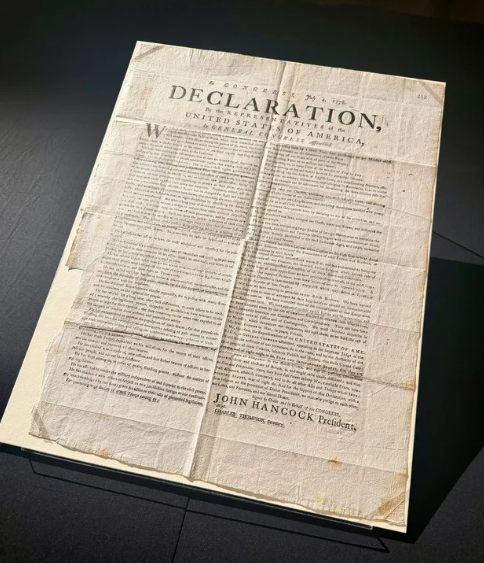
U.S. Declaration The captured ship was returned to Britain, where its papers—including the privateer’s commission, instructions from the Continental Congress, and the Declaration itself—were seized. Historian Moore notes that the Declaration was discovered folded within the letters of Captain Thomas Fitzherbert, arriving in Plymouth in January 1777 before being moved to Whitehall in London. Initially, it was unspecifically referenced by a Royal Navy captain as “another paper” and remained concealed in state archives for centuries.
U.S. Declaration Moore emphasizes that this document is the only known copy of the Declaration acquired through military action. It has undergone conservation efforts to stabilize the paper and mend a slight tear, making it suitable for handling, study, and future exhibition. This rare copy will feature in the exhibit “Revolution 250: America’s Independence Story, 1763-1783” at The National Archives, which already houses three of the original official copies printed by John Dunlap in Philadelphia on July 4, 1776. Approximately 200 copies were printed that night, with only 26 recognized as having survived to present day.
U.S. Declaration After the National Archive identified a rare copy of a significant document, they performed a “careful conservation” process to address a slight tear and stabilize the paper. Dr. Graham Moore, a curator at the National Archive, emphasized the rarity of this form of the Declaration, noting it was originally printed rapidly for wide distribution, making its preservation unusual. The copy’s provenance, being aboard the ship Dalton, is crucial as it signifies the document’s importance and meaning for the crew. Dr. Moore remarked that for the men on the Dalton, the copy articulated both the cause for which they were fighting and its significance.
Pingback: Breaking:Top Retired General Issues Scathing President Trump Take down 3 July - internationalmediawire.com