AI is currently experiencing an unprecedented financial influx, (AI Investment Race 2026) with investments surpassing those seen in historical technological booms such as the railroads and the internet. The total global expenditure on infrastructure related to AI, particularly data centers, is projected to reach around $30 trillion by 2050, approaching the total value of outstanding US Treasuries. This staggering investment underscores the significance of AI in shaping the global economy and indicates a transformative potential that could lead to substantial economic gains. According to a projection by PwC, this investment in AI infrastructure “dwarfs” the capital allocations made during previous technological revolutions, even when accounting for inflation.

AI Investment Race 2026 This raises critical questions about the capability of such investments to deliver tangible economic benefits before financial resources dwindle.Spending on data centers is projected to exceed $30 trillion by the year 2050, according to a new study. In addition, Anthropic has outlined plans to invest $518 billion as detailed in its recent prospectus. Meanwhile, JP Morgan has noted that productivity gains in the United States continue to be ‘elusive.’ Bain & Company warns that artificial intelligence firms may need to explore new markets for growth, rather than relying solely on cost savings.
AI Investment Boom Faces Questions Over Productivity Gains
AI Investment Race 2026 Historical patterns indicate that past technological revolutions have taken decades to significantly impact productivity levels. Meanwhile, Anthropic, a significant player in the AI sector, intends to invest $518 billion over the coming years, as outlined in its IPO prospectus reviewed by Reuters. This investment is poised to exceed 100 times the company projected revenue for 2025. Proponents of AI argue that this technology will usher in transformations more profound than those instigated by the introduction of steam engines and the subsequent industrialization.
However, underneath the ambitious forecasts and substantial financial commitments by AI companies, there exist assumptions regarding substantial productivity enhancements and anticipated profits. Economists caution that these claims are not supported by sufficient evidence or historical benchmarks to guarantee their realization, raising questions about the sustainability and viability of such predictions.
Selected U.S Capital Expenditure Booms
Capex as a percentage of U.S. GDP

Selected U.S. capital expenditure (capex) booms are critically examined in the context of their impact on the overall economy, specifically focusing on capex as a percentage of U.S. GDP. Over time, particular episodes of high capital investment have been noted for their correlation with robust economic growth phases. These booms often result from various factors, including changes in business sentiment, technological advancements, and fiscal policies that encourage investment in infrastructure and capacity expansion.
AI Investment Race 2026 By analyzing historical trends in capex relative to GDP, one can discern patterns that illuminate the cyclical nature of economic expansions and contractions, thereby providing insights into the underlying mechanisms driving growth. Furthermore, understanding the implications of capital expenditure on productivity and long-term economic health remains a topic of interest for policymakers and economists alike.
Productivity Gains Remain Elusive
AI Investment Race 2026 JP Morgan analysis from August highlights that widespread productivity gains in the US, a leader in the AI sector, “remain elusive,” casting doubt on the long-term viability of current AI valuations. Complementing this, a study by Bain & Company indicates that the productivity improvements expected from existing markets are insufficient to justify current investments. It emphasizes that entirely new markets must be developed to bridge the financial gap.

AI Investment Race 2026 These potential markets could include advancements in AI-powered robotics and the creation of new materials for batteries and semiconductors. Moreover, the report notes that US hyperscalers, such as Google, Amazon, and Microsoft, alongside other firms engaged in the AI race, must generate over $4.2 trillion in new revenue within the next five years to finance the necessary infrastructure expansion. The central concern posed in Bain study is whether the required applications will materialize in time to support these ambitious financial goals.
AI Investment Race 2026 The transformative potential of Artificial Intelligence (AI) is widely acknowledged, with its capability to revolutionize various sectors ranging from office environments to research laboratories. This transformation is comparable to previous technological revolutions that significantly reduced travel times and enabled global connectivity through simple digital interactions. However, the underlying economic principles, particularly those governing return on investment and loan repayment timelines, present challenges that must be carefully analyzed.
AI Investment Race 2026 Economists are tasked with evaluating the broader implications of AI on the global economy, particularly as it relates to cycles of investment and technological advancement. Historical trends indicate that economic booms driven by technology often come to an end once the infrastructure developments fail to generate adequate returns, as pointed out by JP Morgan.
AI Investment Race 2026 Using Nvidia as a pivotal example, JP Morgan has articulated that in order for the company valuation to be justified, the United States needs to achieve annual productivity gains ranging between 3% and 5% over the next decade. This projection significantly surpasses the US Congressional Budget Office baseline expectation of 1.75% productivity growth for the same timeframe.

AI Investment Race 2026 Focusing specifically on the US market, which is estimated to contribute approximately three-quarters of the global AI investment, projected investments in AI are set to reach around $9 trillion from 2025 to 2032. This investment translates to an annual expenditure amounting to 3.2% of the US GDP. Stijn Van Nieuwerburgh, an economist at Columbia Business School, further suggests that the US AI sector would need to generate about $3.55 trillion in annual revenue by 2032 in order to yield a 10% return on investment.
Presently, the sector achieves only a fraction of this expected revenue, indicating significant growth and productivity enhancements are essential for long-term valuation and financial viability. The leveraged structure of debt funding for AI infrastructure is susceptible to significant losses, as indicated in a conference paper revised in October. A slight decline in demand, delays, or decreases in asset values can result in disproportionately large financial impacts.
AI and the Rate of New Innovations
AI Investment Race 2026 The discourse surrounding artificial intelligence (AI) has been marked by fervent optimism from industry leaders, who highlight the transformative potential of AI technologies. Notable figures like Dario Amodei of Anthropic and Sam Altman of OpenAI have expressed their visions of an AI-driven future characterized by “transcendent beauty” and an “immense” rate of new achievements. This enthusiasm is largely rooted in advancements in recursive self-improvement a process where AI models enhance their own capabilities, leading to what Jasjeet Sekhon from Google DeepMind termed as significant productivity gains.
Sekhon emphasized that this self-teaching mechanism is central to investment strategies in AI development, suggesting that it holds the promise of unprecedented advancements in productivity. However, the excitement is tempered by caution; the rapid evolution of AI technologies also raises serious existential concerns for humanity. Furthermore, there are apprehensions that the swift changes in productivity may not align with the timelines demanded by businesses, potentially leading to mismatches in expectations versus reality in corporate financial planning. AI Investment Race 2026

AI Investment Race 2026 Diane Coyle, an economist from Cambridge University, noted that the productivity effects of past revolutionary technologies typically take 10 to 50 years to manifest fully. A team at Anthropic modeled various scenarios regarding AI potential to enhance economic growth by 2030. With a baseline growth rate of 2% in a non-AI environment, they projected an increase to 2.4% in a scenario with modest AI impact, 5.4% with substantial impact, and a striking 15.4% under extreme conditions. However, the anticipated higher growth could lead to increased job losses, though the report stops short of assigning probabilities to these outcomes. Previously, Amodei predicted that AI could eliminate half of entry-level white-collar jobs within five years.
AI Investment Race 2026 Currently, some researchers suggest that AI impact is mainly making it increasingly difficult for job seekers in office roles to find employment. Studies in the US and Britain reveal a notable deceleration in the hiring of early career white-collar positions that involve tasks easily performed by AI, despite the overall employment landscape remaining robust. Research by Stanford University indicates that employment among workers aged 22 to 25 in industries vulnerable to AI, such as accounting and legal work, is 19% lower compared to sectors where AI struggles to replicate human skills, like janitorial and construction jobs.
AI Investment Race 2026 This trend suggests that while the anticipated impact of AI may unfold more slowly than some projections suggest, the tangible economic advantages associated with AI adoption are likely to endure. Historical precedents illustrate that significant innovations, much like the railways post-Panic of 1873 or the internet following the dot-com crash, persist and grow despite initial setbacks. As noted by researcher Coyle, retaining the necessary infrastructure to support productivity enhancements in the future is crucial, asserting that the journey through these changes is manageable as long as foundational elements remain intact.
AI investment boom sets new records
Historical investment surges: a comparison
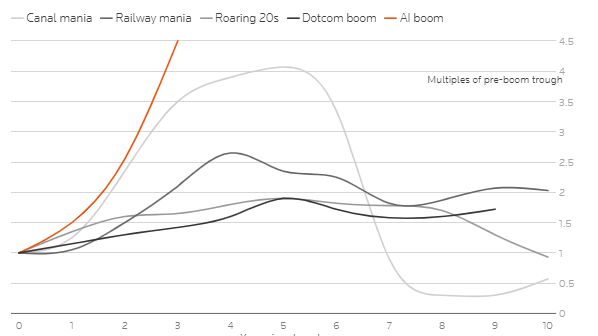
AI Investment Race 2026 The historical investment surge in artificial intelligence (AI) is setting new records, drawing comparisons to several major economic booms throughout history. Notably illustrated through a chart, the AI investment boom is contextualized against four historical episodes: canal mania in the United States starting in 1835, railway mania in Great Britain from 1843, the economic exuberance of the 1920s in the United States beginning in 1921, and the dotcom boom that commenced in 1995.
AI Investment Race 2026 The chart measures investment levels as multiples of each boom pre-boom trough, effectively highlighting the unprecedented magnitude of current AI investments. This upward trend in funding represents a significant leap in AI hyperscaler capital expenditures starting from 2023, with forecasts extending to 2026 based on announced guidance. The document is sourced from BIS Working Paper No 1367 authored by Phurichai Rungcharoenkitkul, which analyzes the AI investment race, emphasizing its historical significance and potential for future growth when compared to earlier innovation-led economic expansions.
Summary
- Spending on data centers to top $30 trillion by 2050, study says
- Anthropic plans to spend $518 billion, prospectus shows
- US productivity gains ‘remain elusive’, says JP Morgan
- AI firms may need new markets not just savings, says Bain
- Past tech revolutions took decades to transform productivity
What is the AI trillion dollar race?
The AI trillion dollar race is characterized by significant investments from major tech companies, including Microsoft, Google, and OpenAI, which are collectively aiming to invest over $1 trillion in AI infrastructure, chips, and data centers by the year 2026. This race is driven by the objective of establishing dominance in the rapidly growing AI economy.
How much is being invested in AI globally?
AI Investment Race 2026 Global investment in AI is projected to exceed $1 trillion by 2025-2026, covering expenditures on semiconductors, cloud infrastructure, and AI models.
Can AI investment transform the global economy?
AI Investment Race 2026 A significant investment in AI has the potential to transform the global economy by enhancing productivity, fostering the emergence of new industries, and automating various jobs. However, the anticipated productivity gains have not yet materialized, and their realization hinges on effective implementation of AI technologies.
Which companies are leading the AI investment race?
AI Investment Race 2026 Leading the AI investment race are Nvidia, Microsoft, Alphabet (Google), Amazon, Meta, and OpenAI. This surge is primarily driven by significant capital expenditures in the U.S.
What are the risks of the AI investment boom?
Risks associated with the AI investment boom encompass several factors. Over-investment in AI technologies could lead to bubble formation in the market. Additionally, the high energy consumption related to AI operations poses significant concerns. Job displacement remains a critical issue, as automation may replace human jobs. Furthermore, there is apprehension that the anticipated productivity gains from AI advancements may not warrant the substantial financial commitments being made.
Pingback: AI-Controlled F-16: How Autonomous Fighter Jets Are Changing Air Combat in 2026 - internationalmediawire.com
Pingback: Report What Will Washington Do Next if US Bond Yields Keep Rising? - internationalmediawire.com
Pingback: US Inflation Rises More Than Expected as Consumer Prices Continue to Climb - internationalmediawire.com
Pingback: Google Staff Resign in Backlash Over Its AI Contracts With Military - internationalmediawire.com