Tariffs: Canada Prime Minister Mark Carney has emphasized that the shift in trade partnerships away from the U.S. due to ongoing tariff disputes will impose significant costs on the nation. In a recent video address, Carney announced a series of retaliatory tariffs targeting approximately C$28 billion (around $20 billion) worth of American imports, which will affect a range of goods including steel, furniture, and cotton T-shirts, with some tariffs reaching as high as 50%.

Despite both U.S. and Canadian officials expressing a desire to negotiate, formal talks have not resumed since negotiations fell apart in late August. Carney pointed out that these measures are crucial for safeguarding Canadian workers and highlighted the government commitment to diversifying trade relationships and strengthening the economy amid these tensions.
He emphasized that his government would provide support to workers impacted by the ongoing trade conflict with the United States “for as long as it takes.” The prime minister stated, “We have everything we need to pivot and prosper,” acknowledging that this shift would entail costs, asserting that “there’ lways a cost to action, but it doesn’t come close to the cost of standing still.” Meanwhile, US Trade Representative Jamieson Greer indicated that the Trump administration is contemplating implementing retaliatory tariffs on Canada soon.
President Trump previously threatened to suspend all business with Bombardier, a major Canadian aerospace manufacturer, unless it relocated its manufacturing operations to the United States. Bombardier is a significant contributor to Canada economy, projected to add over C$7 billion to the country GDP in 2024, as noted in a report by PwC commissioned by the company. Trump contends that such import taxes compel consumers to purchase American-made products and attract foreign investment into the U.S. Yet, economists caution that tariffs may lead to increased prices for consumers on essential goods targeted by these taxes.
Over the weekend, Trump criticized Canada in a series of posts on Truth Social.Another post displayed a map illustrating North America, encompassing Canada, Mexico, and Greenland, all superimposed with the US flag. This visual representation highlights the significant bilateral trading relationship between Canada and the United States, valued at nearly $900 billion in the previous year. The economic disparity is notable, with the US economy approximately 13 times larger than that of Canada.

This economic dynamic means that the majority of Canadian exports are directed toward the US market, creating a crucial interdependence for businesses on both sides of the border. Currently, the US has imposed a 25% tariff on Canadian automobiles, alongside additional tariffs on Canadian steel, aluminum, and lumber. These trade barriers have led businesses to proactively strategize and adapt to the evolving economic landscape and the potential implications for cross-border trade.
Golf clubs, cheese, toilet paper
In late August, President Trump implemented new tariffs of 50% on various goods, including dairy products, alcohol, hockey sticks, and perfume. In retaliation, Canada announced counter-tariffs, which are set to impose additional duties ranging from 15% to 50% on a wide array of American imports starting Tuesday. Notably, American milk, golf clubs, steel, aluminium, jackets, and T-shirts will incur the steepest 50% tariffs.
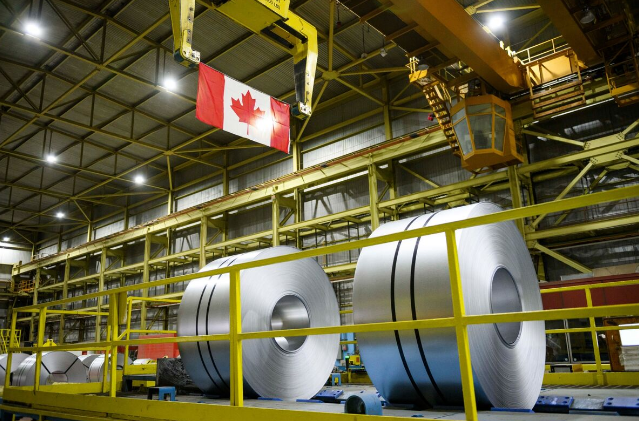
Furthermore, household items such as cheese and toilet paper will face a 25% tariff, while industrial products like forklift trucks and moulds will be subjected to a lower tariff rate of 15%. These new tariffs add to the existing retaliatory taxes that Canada has already placed on American-made cars and trucks, which are not covered under the US-Mexico-Canada Agreement (USMCA), or known as CUSMA in Canada. This escalating trade dispute highlights the increasingly strained economic relations between the two countries.
Impact of Canadian counter-tariffs on US states
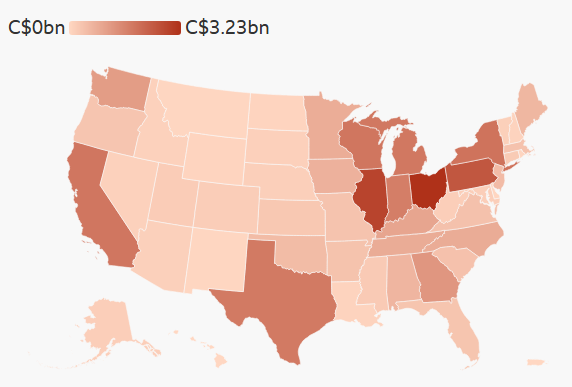
Value of US exports to Canada to be affected by tariffs (in billions of C$)
Opinion polls indicate that a significant majority of Canadians favor their government implementing retaliatory tariffs against the United States. In response, the Canadian Chamber of Commerce has advised the Carney government to adopt a precise and measured strategy for retaliation, emphasizing that while businesses are in favor of such actions, they prefer to avoid an escalation of tensions. Candace Laing, the Chamber CEO and President, highlighted to the BBC that the business community is concerned about the potential for a prolonged conflict.
The fisheries sector has been particularly vocal in its opposition, leading Canada to modify its counter-tariffs by excluding numerous seafood items. This decision aims to prevent any negative repercussions on Canada own economy. The lobster industry exemplifies the interconnectedness of the Canadian and American markets, as it relies heavily on a reciprocal trading relationship, where American-caught lobsters are often sent to Canada for processing before being returned to the U.S. for sale.

Canada economy demonstrated notable resilience prior to the implementation of new tariffs, with a reported 3.3% GDP growth in the second quarter and an addition of 181,000 jobs from April through July. However, this positive trend experienced a setback in August, with the loss of approximately 41,000 jobs, a development linked to the recently imposed US tariffs and the breakdown of trade negotiations.
Interestingly, the manufacturing sector reported modest growth, attributed by the Canadian government to an increase in domestic consumption of Canadian-made products. Moreover, Canada is actively diversifying its trade relationships; data indicates that exports to the US have decreased from an average of 75% to 66% of total Canadian exports as of July, reflecting a strategic shift in trade dynamics.